
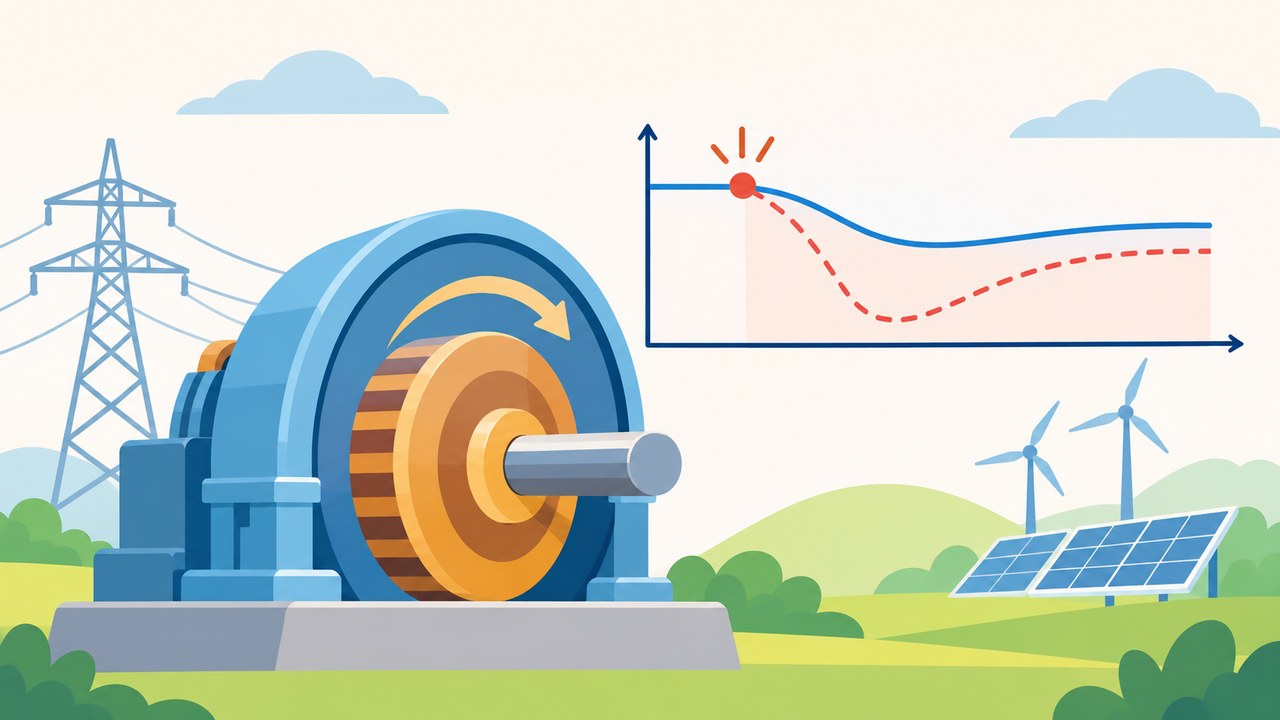
As renewable energy changes the way electricity is generated, an old property of conventional power plants is becoming increasingly important. It is called inertia, and it plays a crucial role in keeping the power system stable. Imagine a large generator suddenly disconnecting from the grid. The power it was supplying disappears, but electricity demand does not. For a brief moment, the system has a generation deficit. What happens next is important. Before governors can increase mechanical input, batteries can respond, or other control systems can take corrective action, something must slow down the rate at which grid frequency falls. That first response comes from inertia.
For decades, inertia was an almost automatic feature of power systems, provided by the rotating masses of large synchronous generators. But as conventional generation is increasingly complemented by converter-connected renewable sources, the way power systems obtain inertia is changing. To understand why this matters, we first need to understand what inertia actually is.
What is grid inertia?
In mechanics, inertia is the resistance of an object to a change in its state of motion. A heavy flywheel, for example, is difficult to accelerate or decelerate because it stores kinetic energy. The same principle applies to a power system. Large synchronous generators have heavy rotating masses, and while connected to the grid, their rotors spin at a speed corresponding to the system frequency. In a 50 Hz system, this is typically 3,000 rpm for a two-pole machine or 1,500 rpm for a four-pole machine. Together, these rotating machines store a substantial amount of kinetic energy.
When a generator suddenly trips, the electrical power supplied to the grid decreases immediately. However, the mechanical power driving the remaining generators cannot change instantaneously. The imbalance is initially absorbed by the kinetic energy stored in their rotating masses. The rotors slow down slightly, releasing energy into the system and helping limit the initial fall in frequency. This response is inherent to the physics of synchronous machines, and it does not require a controller to detect the disturbance and issue a command.
The relationship is described by the swing equation:
2H · dω/dt = Pm − Pe
Here, H represents the inertia constant, ω is rotor speed, and Pm and Pe are mechanical input and electrical output respectively. The important point is simple: for the same generation loss, lower inertia results in a faster change in frequency. This is known as the Rate of Change of Frequency, or RoCoF. Inertia does not prevent frequency from changing. It slows down that change, giving the system more time to respond.
How is inertia measured?
The inertia of a synchronous machine is represented by a parameter called the inertia constant, denoted by H. It is defined as:
H = E / S
Where E is the kinetic energy stored in the rotating mass and S is the machine’s rated apparent power in MVA. Since energy divided by power gives time, the inertia constant is expressed in seconds. For example, a machine with an inertia constant of 5 seconds stores kinetic energy equivalent to five seconds of its rated power output. For an entire power system, the inertia contributions of connected synchronous machines are combined, taking their individual ratings into account.
But here is an interesting challenge: system inertia cannot simply be read from an instrument in a control room. Engineers generally estimate it by observing how the system responds to a disturbance. They measure the generation lost and the resulting change in frequency, then use the swing equation to infer the system’s inertia. This is where accurate frequency measurement becomes important.
Frequency measurements contain noise, so they need to be filtered before RoCoF can be calculated. However, the choice of filter and measurement window can significantly affect the result, and ENTSO-E has demonstrated that the same recorded event can produce RoCoF values differing by a factor of ten under different filtering methods. Modern Phasor Measurement Units (PMUs) have made such monitoring more practical. Unlike conventional SCADA systems, which typically operate with measurements at intervals of seconds, PMUs provide measurements at much faster rates, allowing operators to observe grid dynamics that unfold within milliseconds. In other words, the challenge is not only to calculate inertia, but also to measure the system’s response accurately enough to make that calculation meaningful.
Why do a few seconds matter so much?
The importance of inertia becomes clearer when we look at the different timescales involved in frequency control. A disturbance can occur within milliseconds, and inertia responds immediately. Primary frequency control, mainly through generator governors, acts over the following seconds and tens of seconds. Secondary control operates over minutes, while tertiary control and generation rescheduling may take considerably longer. Inertia therefore acts as a bridge between the disturbance and the arrival of corrective action. It does not replace the power that has been lost. Instead, it slows the frequency decline long enough for other control mechanisms to respond.
When system inertia is low, frequency can change much faster following a disturbance, and this creates several challenges. Under-frequency load shedding schemes may operate earlier, disconnecting consumers to restore the balance between generation and demand. High RoCoF can also affect protection systems, potentially causing unwanted tripping or preventing protection from responding effectively.
There is another important consequence. Lower inertia can reduce transient stability margins, including the critical fault clearing time. This means a power system may have less time to clear a fault before synchronous machines risk losing synchronism. The issue, therefore, is not simply about maintaining frequency at 50 Hz. It is about ensuring that the system has enough time to withstand disturbances without triggering a chain of further problems.
Why is inertia reducing in modern grids?
Traditionally, most electricity was generated by synchronous machines in thermal, hydro and nuclear power plants, and their rotating masses provided inertia as a natural by-product of electricity generation. The increasing integration of wind and solar power is changing this arrangement. Most solar photovoltaic plants are connected to the grid through power electronic converters, so they do not have large synchronous rotating generators directly coupled to the grid.
Wind turbines do have rotating masses and store kinetic energy. However, their converters largely decouple the turbine’s mechanical speed from grid frequency. As a result, this stored energy does not automatically contribute to grid inertia in the same way as a conventional synchronous generator. As more converter-connected generation enters the system, and fewer synchronous generators remain online, the available physical inertia can decline.
However, a high renewable share does not automatically mean low inertia. The actual inertia available at any moment depends on which synchronous machines are connected, their ratings and operating conditions, as well as interconnections with neighbouring systems. Inertia is therefore not a fixed characteristic of a power system. It changes with generation dispatch and system operating conditions.
Can technology recreate what physics once provided for free?
The good news is that the industry is developing several ways to address declining physical inertia. One approach is synthetic inertia, where control systems are designed to make converter-connected resources respond to frequency changes in a manner similar to synchronous machines. Wind turbines, for example, can briefly release some of their stored rotational energy by increasing electrical power output and slowing down their rotors, while grid-forming converters, particularly when supported by battery energy storage, can be controlled to provide fast frequency response and emulate aspects of synchronous machine behaviour.
Another option is the synchronous condenser. It is essentially a synchronous machine operating without a prime mover or generating active power. It can provide physical inertia, reactive power support and short-circuit strength, making it useful in systems with high converter-connected generation.
However, synthetic inertia is not an exact replacement for physical inertia. A synchronous machine provides an immediate physical response, whereas a converter must detect the frequency change and respond through its control system. This introduces delays, while converter current limits and available energy restrict the response. The technology is valuable, but its performance depends on control design, operating conditions and the energy available to deliver the response.
What does this mean for the grid of tomorrow?
India has already begun examining this issue in detail. In its January 2022 report on the assessment of inertia in the Indian power system, POSOCO highlighted the importance of monitoring inertia as renewable energy integration increases. The report assessed kinetic energy across conventional generating units and recommended measures including synchronous condensers, synthetic inertia, improved frequency response and standardised RoCoF measurement. It also emphasised that regional inertia matters, since a healthy national total does not necessarily mean that every region has sufficient inertia to withstand disturbances.
The larger lesson is that inertia can no longer be treated as an automatic by-product of conventional generation. It is becoming a parameter that system operators and planners must actively monitor, forecast and manage. As power systems evolve, the challenge will not simply be to generate electricity from cleaner sources. It will also be to ensure that the grid remains stable when the conventional rotating machines that once supported it are no longer operating in the same numbers.
The physics of inertia has not changed. What has changed is the way we generate electricity, and consequently, the way we must provide the stability that the grid needs.
Leave a Reply