
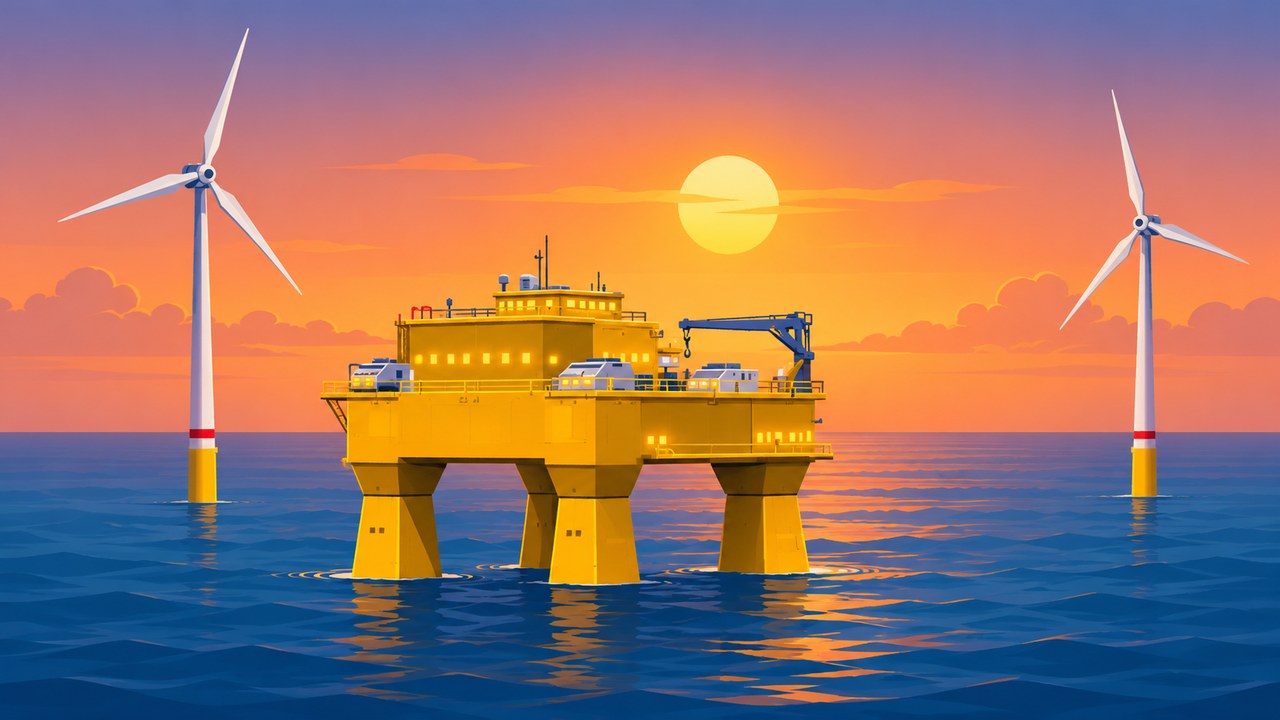
An interesting thing about electrical circuits is that current needs a complete path to flow. In an AC transmission system this is generally achieved through three phase conductors, while in a DC system a return path is also required to complete the circuit.
In HVDC transmission, this return path does not always need to be another metallic conductor. The earth or seawater can also be used to carry the return current between two converter stations.
At first, this sounds like a very attractive arrangement. The earth is already available, so why install an additional conductor when the ground itself can complete the circuit?
In fact, this idea is not new. Earth and sea return arrangements have been used in several HVDC projects around the world. However, their use also introduces some engineering challenges, particularly related to corrosion, stray currents, interference with nearby infrastructure and environmental considerations.
Let us understand how it works, and why it is not always the preferred arrangement.
How can earth be used as a return path in HVDC?
To understand earth return, let us first look at a conventional bipolar HVDC system.
A bipolar HVDC system has two main transmission conductors, one operating at positive polarity and the other at negative polarity with respect to earth. Under normal balanced operation, the current flowing through one pole is approximately equal to the current flowing through the other pole, but in opposite directions.
As a result, the currents balance each other at the converter station neutral points, and ideally there is almost no current flowing through the earth.
However, the situation changes when one pole becomes unavailable. Suppose the positive pole is taken out of service due to a fault or maintenance. If the system has been designed with earth-return capability, the healthy negative pole can continue transmitting power using the earth as the return path. This allows the HVDC link to continue operating, although generally at reduced power transfer capacity.
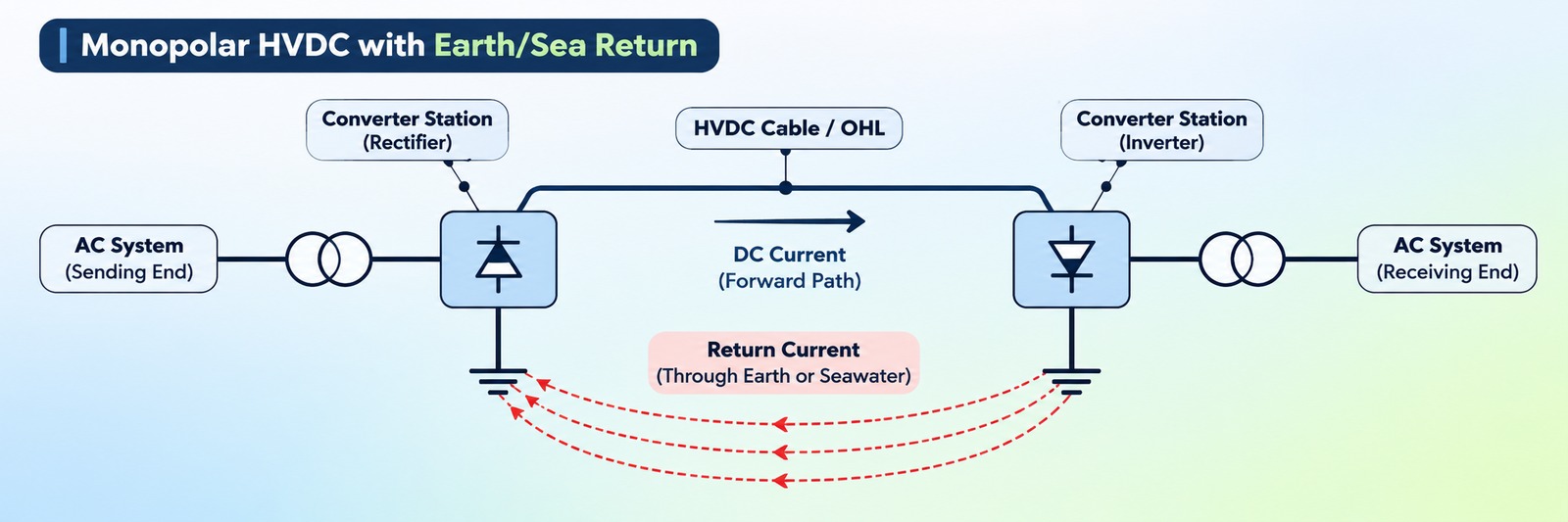
The same principle can also be used in a monopolar HVDC system. In this arrangement only one main transmission conductor is installed, while the earth or seawater provides the return path. For this purpose, special installations called earth electrode stations are provided at both ends of the HVDC link. Each converter station is connected to its corresponding electrode station through an electrode line.
When the HVDC system operates with earth return, current enters the ground through one electrode. It then spreads through the surrounding soil or seawater, travels towards the other electrode and converges there. The second electrode collects the current and provides the return connection to the other converter station.
How has earth return been used in HVDC schemes around the world?
One of the earliest examples of earth and sea return was the Gotland HVDC link in Sweden, commissioned in 1954. The world’s first commercial HVDC transmission system used a single submarine cable, with seawater providing the return path. This avoided the need for a second submarine cable.
Earth return has also been used in other HVDC schemes, including Nelson River in Canada and Cahora Bassa between Mozambique and South Africa, particularly during periods of monopolar operation. Submarine links such as Baltic Cable and Fenno-Skan have also used sea electrodes as part of their operating arrangements. Many of these are classic line commutated converter schemes that are still very much in service today.
In India, the ±500 kV Talcher-Kolar and ±800 kV Northeast-Agra HVDC Projects are designed to support monopolar operation with ground return under specified conditions.
Traditionally, therefore, earth or sea return has been an integral part of HVDC system design. It provides an alternative current path when one pole is unavailable, or forms part of the intended arrangement in certain monopolar links.
What are the problems associated with earth return?
The main challenge is that the earth is not a controlled metallic conductor. Large DC currents flowing through soil or seawater can affect buried metallic structures, nearby electrical systems and the surrounding environment. There are several important engineering concerns.
1. Electrochemical corrosion
When stray DC current leaves a buried metallic structure and enters the soil, the point of discharge can become anodic. Metal atoms lose electrons and enter the surrounding electrolyte, gradually causing corrosion.
Buried pipelines, cable sheaths and grounding systems can be affected, sometimes even at considerable distances from the HVDC electrode. Such corrosion may remain unnoticed for years before causing damage.
2. Stray DC currents and interference
The earth does not provide a perfectly isolated return path. Some current may flow through nearby pipelines, railway tracks or other metallic structures, potentially affecting railway signalling, telecommunication and other installations.
DC current entering AC grounding networks can also affect transformers with grounded neutrals. Depending on its magnitude and duration, it may cause partial core saturation, increased harmonics, heating and reactive power consumption.
3. Environmental concerns
DC current entering or leaving the soil or seawater causes electrochemical reactions around the electrode. These reactions may change local chemical conditions and produce gases or other substances, depending on electrode design and operating conditions.
Local heating and possible effects on soil or marine life must also be considered. Electrode design therefore requires environmental assessment in addition to electrical calculations.
4. Ground potential rise and safety
Current injection into the earth creates a voltage gradient, with the ground potential generally highest near the electrode and decreasing with distance. This can create step and touch voltage hazards for people near the installation.
These voltage differences must be carefully evaluated to ensure that the electrode arrangement does not create unacceptable safety risks.
5. Electrode location and infrastructure requirements
Earth-return operation requires dedicated electrode stations, electrode lines, suitable materials and monitoring arrangements. Finding appropriate locations can be difficult, particularly in densely populated areas or regions with extensive underground infrastructure.
Electrodes are also generally located away from converter station grounding systems to limit DC potential transfer and interference with nearby equipment. This adds land, infrastructure and environmental assessment requirements to the project.
Together, these challenges explain why earth return is not simply a cheaper alternative to a metallic return conductor. Its use requires careful consideration of electrical, environmental, infrastructure and safety constraints.
Is earth return still used today?
Earth return has not completely disappeared from HVDC technology. However, many newer HVDC projects have moved towards a dedicated metallic return instead of relying on earth as the return path during monopolar or unbalanced operation.
This shift is largely driven by concerns about corrosion, stray DC currents, interference with nearby infrastructure and the practical challenges of maintaining earth electrode stations.
A good example from India is the ±800 kV Champa-Kurukshetra HVDC Project, commissioned with a dedicated metallic return conductor. It was the first ±800 kV project in the world to use this arrangement. The decision was taken to avoid the operational and environmental concerns associated with ground-return operation.
With a dedicated metallic return arrangement, a separate metallic conductor provides the return path when one pole is unavailable. This avoids passing the full return current through the soil and reduces the risk of stray-current-related problems. However, it adds the cost of an additional conductor and its associated infrastructure.
The choice is not universal. Some submarine HVDC links still use sea electrodes, while other projects use earth electrodes or metallic return depending on their technical and geographical requirements. Modern HVDC designs may also use rigid bipolar configurations that do not require a separate return conductor, and future multi vendor HVDC grids will bring their own set of return path questions.
The trend, therefore, is towards limiting dependence on earth return where it creates operational or environmental challenges. Earth return remains a technically valid option, but dedicated metallic return has become an important alternative in many newer projects.
The earth can complete the circuit, but should it?
Earth is capable of carrying HVDC return current, and its use has been demonstrated in several transmission projects around the world. However, the decision to use it involves much more than electrical conductivity or the cost of an additional conductor.
The possibility of electrochemical corrosion, stray DC currents, interference with nearby infrastructure, environmental effects and safety concerns makes earth-return operation a carefully evaluated engineering choice. While metallic return arrangements are preferred in many applications, earth and sea return continue to have an important place in HVDC technology, particularly where the technical and geographical conditions make them suitable.
The earth can complete the electrical circuit. Whether it should be used as the return path is a much bigger engineering question.
Leave a Reply