
The global transition to renewable energy has introduced one of the greatest geographical puzzles in the history of electrical engineering: the places that generate the most clean energy are rarely the places that consume it. The sunniest deserts and windiest coastlines are often thousands of kilometers away from industrial mega-cities. To bridge this gap, High-Voltage Direct Current (HVDC) transmission has reemerged as the defining infrastructure of the 21st-century grid, allowing operators to move massive amounts of power over vast distances without the crippling reactive power losses associated with alternating current (AC) lines.
Emergence of VSC HVDC
In recent years, the engineering community has been heavily focused on the rise of Voltage Source Converter (VSC) HVDC. Because VSC technology utilizes transistors that can be turned on and off electronically, it offers exceptional grid control and flexibility. It doesnt need a strong AC grid to operate; it can black start a dead grid and control both active and reactive power.
This makes VSC the perfect technology for connecting offshore wind farms to the mainland or feeding power into weak, isolated AC networks. It’s flexible, it has a smaller physical footprint, and it avoids the dreaded commutation failures that plague older tech. As a result, VSC technology has seen a massive surge in adoption over the past decade.
The Reign of LCC HVDC is Not Yet Over
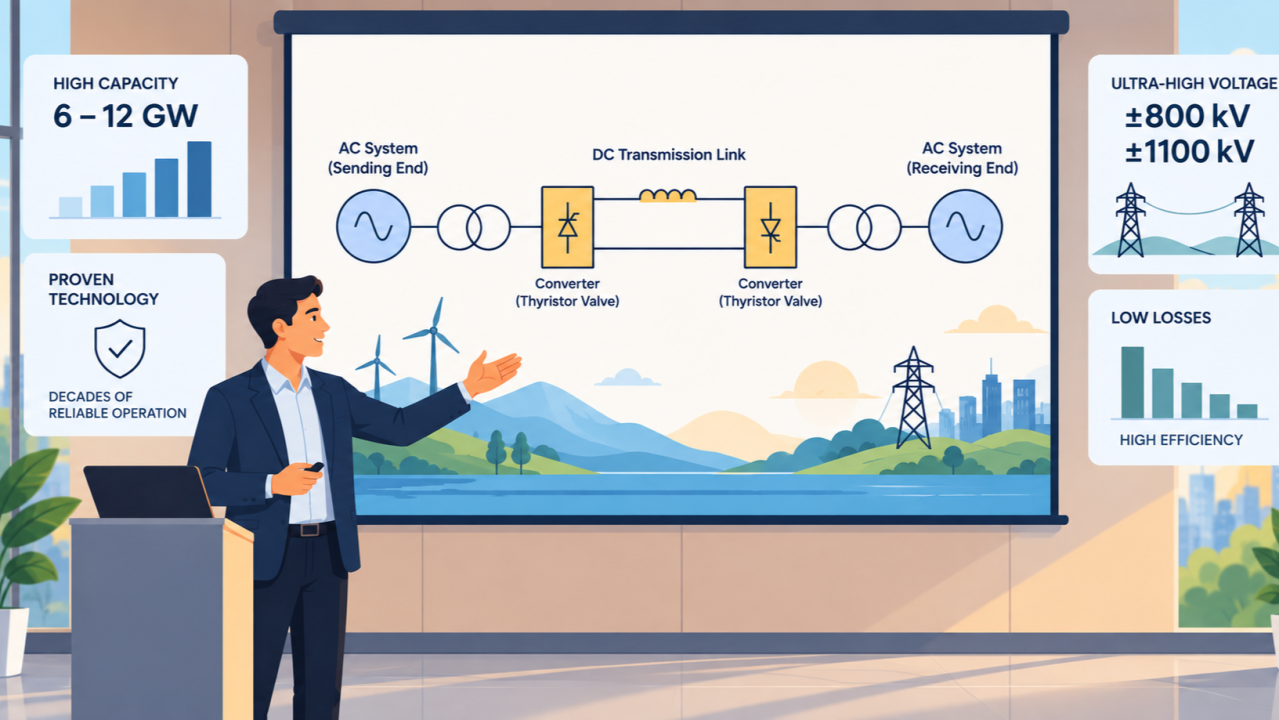
However, despite the clear operational advantages of VSC, the original standard for DC transmission, Line-Commutated Converter (LCC) HVDC, remains fundamentally indispensable. LCC technology, which utilizes robust thyristor valves, is sometimes viewed as classic technology, yet it continues to serve as the backbone for the world’s highest-capacity transmission corridors.
The primary technical divergence between the two technologies lies in power handling and efficiency. While state-of-the-art VSC systems are currently pushing capacities of 2 to 3 Gigawatts (GW), modern LCC systems routinely handle 6 to 12 GW. Furthermore, LCC has successfully scaled to Ultra-high voltage (UHVDC) levels of ±800 kV and ±1100 kV.
Market Reality: Project Count vs. Transformation Capacity
The current market dynamic is a fascinating tale of two metrics: project volume versus transformation capacity. If you look at the sheer number of new projects globally, VSC is taking the lions share. Between 2023 and 2025, roughly 62% of new HVDC project announcements incorporated VSC technology. This shift is heavily driven by the boom in European offshore wind grids and point-to-point interconnectors, where VSCs footprint and modularity are necessary. However, if you measure by bulk GW capacity, LCC still holds a massive, irreplaceable footprint. The world’s biggest energy corridors, the true mega-projects, still rely on thyristor-based LCC technology to do the heavy lifting.
India and China are investing heavily in LCC HVDC technology. India has recently announced major LCC HVDC projects as part of its plans to evacuate large amounts of renewable energy over long distances. Key initiatives include the ±800 kV 6000 MW Bhadla–Fatehpur link, which will transmit renewable power from the Bhadla renewable energy zone in Rajasthan towards Fatehpur in Uttar Pradesh. Similarly, the ±800 kV 6000 MW Barmer South–Kalamb corridor is being developed to transfer green energy from western Rajasthan to South Kalamb in Maharashtra. Additionally, the ±800 kV 6000 MW Khavda–Nagpur project is currently under construction to further strengthen this high-capacity grid infrastructure. China is also actively planning and building massive LCC-HVDC (and hybrid LCC-VSC) projects to connect remote renewable energy hubs to its major metropolitan centers.
The Backbone of the Future Grid
The evolution of HVDC is not a strict replacement of LCC by VSC, but rather a bifurcation of applications based on specific system requirements. VSC is the optimal choice for system flexibility, multi-terminal networks, and offshore integration. However, for point-to-point, ultra-high-capacity transmission over continental distances, the low losses and high voltage ratings of thyristor-based LCC technology remain unmatched.
As the global energy transition accelerates and the need to transport gigawatts of clean energy across continents grows, LCC HVDC will continue to play a crucial role in modern grid infrastructure for decades to come.
Leave a Reply