
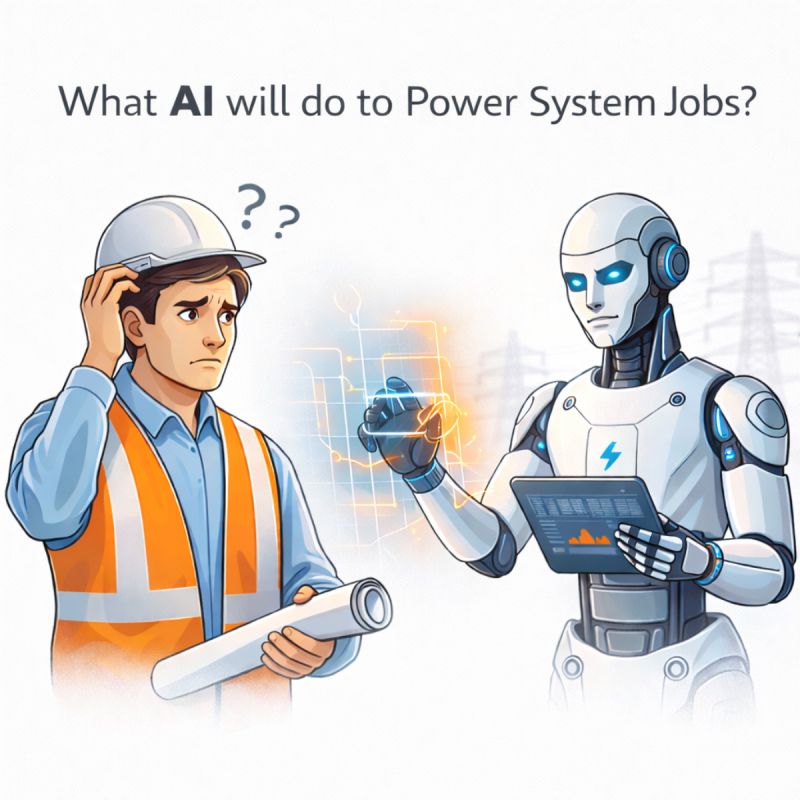
It is not possible to predict the future with certainty. What we can do is observe industry trends and understand how power systems are evolving. From that perspective, we can make informed assumptions about where AI may fit into the future of power engineering.
Jobs that require physical presence in the field, such as commissioning, testing and breakdown maintenance, may not be directly influenced by AI in the near future. A relay still has to be wired. A transformer still has to be tested. Someone still has to stand in the yard and judge whether what the instrument reports matches what the equipment is actually doing. However, roles involving Control and Protection design, verification and validation, RCAs, and fault analysis could see strong influence. These activities are data heavy, logic driven, and increasingly software based.
It helps to ask what makes a task open to automation in the first place. Work that follows a clear procedure, draws on large amounts of recorded data, and produces an answer that can be checked is the work software reaches first. Going through a week of disturbance records to find the events worth reading is that kind of work. Deciding what the protection philosophy for a new scheme should be is not.
If we look back 40 or 50 years, power systems were much simpler. Networks were smaller, generation was centralized, and control strategies were basic. Engineers performed load flow calculations, short circuit studies, and stability checks mostly by hand. Engineering judgment was everything, partly because there was little else to lean on. As grids expanded and renewable integration increased, systems became more interconnected and complex. That is when software tools entered the picture. Platforms like MATLAB enabled simulation and control design. Tools such as DIgSILENT PowerFactory, PSCAD, and RTDS became industry standards.
It is worth remembering what that shift actually did. These tools did not replace engineers. They allowed us to handle larger and more complex networks. What changed was not the need for judgment but the scale at which it could be applied. The engineer who once checked a handful of cases could now check thousands, and the difficult part moved from running the study to choosing which studies mattered and deciding whether the results made sense.
Now we are entering another phase.
Future grids will not just be interconnected. They will be intelligent and decentralized. Think about Multi Terminal DC control and protection. Think about DER coordination across thousands of rooftop solar systems. Think about demand response reacting in real time to grid stress. Think about protection that has to work when much of the fault current comes from inverters rather than synchronous machines. Complexity is increasing rapidly, and it is increasing faster than the number of engineers available to manage it.
AI will likely become another tool, similar to what simulation software once was. It can support predictive maintenance, adaptive protection, real time optimization, anomaly detection, and faster fault interpretation. It can read far more operating data than any team can read by hand, and it can surface the pattern a person would have found eventually, or might have missed altogether. But engineers will still need to design the philosophy, validate outputs, and take responsibility.
That last point is the one that does not move. When a scheme operates incorrectly and a feeder is lost, the question asked afterwards is not what the software recommended. It is what the engineer decided, and on what basis. A tool can produce an answer. It cannot sign for it.
AI may change how we work and reduce repetitive analytical tasks. But power systems involve safety, reliability, and accountability. Engineers will not disappear. They will evolve.
For anyone entering the field now, that evolution is worth preparing for rather than fearing. Learn the fundamentals properly, because you cannot validate an output you do not understand. Get comfortable with data and with scripting, because an engineer who can put a question to a dataset is far more useful than one who waits for a report. And keep the habit of asking why a result looks the way it does, which is the one part of this work that no tool has taken from us.
The real question is not whether AI will take over power system jobs. The question is whether power system engineers are ready to work alongside AI.
Leave a Reply