
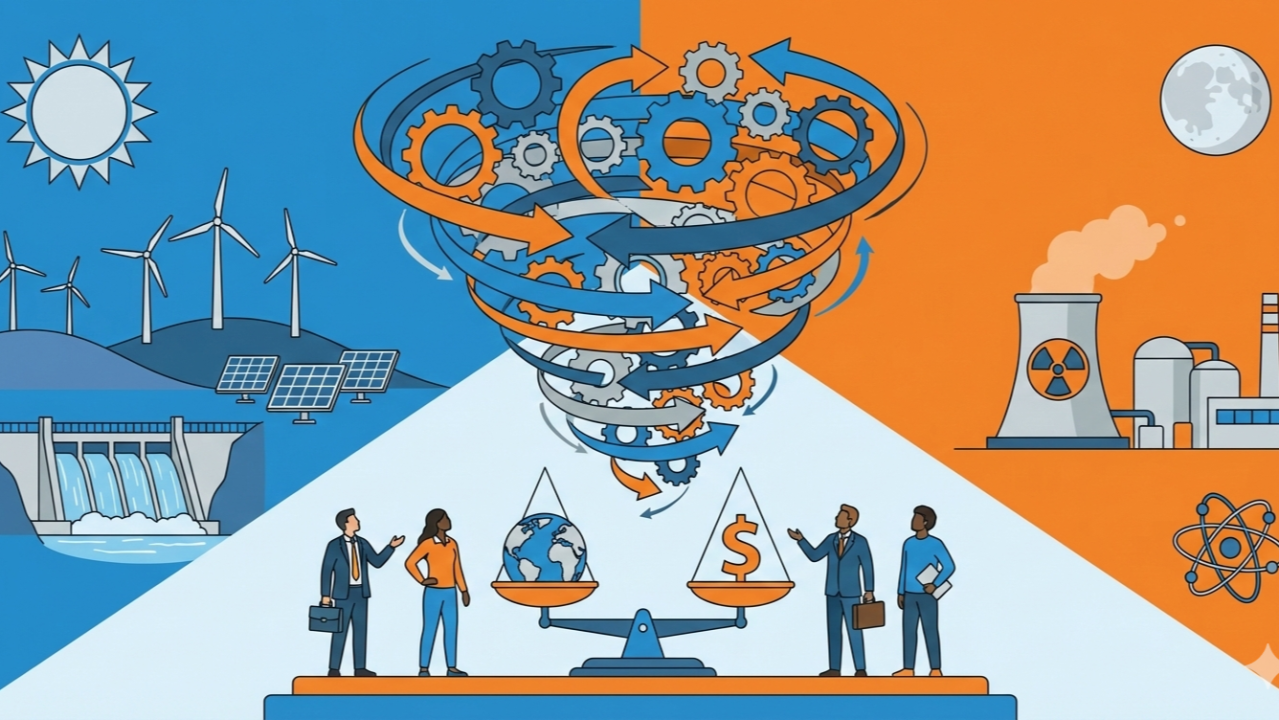
The global energy transition is often presented as a binary choice: the clean promise of renewables versus the stable power of nuclear. This framing oversimplifies a complex engineering and human challenge. Deciding our energy future is not just about technology; it is a negotiation between our desire for safety, our fear of risk, and our relentless drive for economic efficiency. The current debate is trending because these human factors are clashing in real time.
The Pull Towards Ultimate Safety
If we look into the future, the ultimate convergence point for electricity generation appears to be a fully renewable grid. This aligns perfectly with a fundamental human trait: the desire for absolute safety and zero risk to life. Events like Chernobyl and Fukushima have embedded a deep-seated fear of catastrophic nuclear accidents in our collective consciousness. In an age dominated by social media and instant information, public pressure to eliminate any perceived risk will only increase. This pressure pushes policy makers and investors away from nuclear power, despite its clear low-carbon benefits, because the social and political risk profile is simply too high. We want energy that is abundant, cheap, and, crucially, harmless.
The Scalability Challenge of Intermittent Renewables
However, the transition faces immediate, practical hurdles that challenge our goal of economic optimization. The primary issue with solar and wind power is intermittency—the sun does not always shine, and the wind does not always blow. To achieve a reliable, fully renewable grid, we need vast Battery Energy Storage Systems (BESS) and other long-duration storage solutions.
At present, utility-scale BESS is highly effective for short-term grid balancing but is not yet scalable or affordable enough to power entire nations for days or weeks without wind or sun. The sheer material and cost requirements for storing that much energy are astronomical today. Relying solely on renewables right now would force us to burn more natural gas for reliability, defeating the purpose of decarbonization.
The Necessary Bridge: A Phased Approach
We are in a carbon reduction crisis, and we need dispatchable, low-carbon power now. This is where the pragmatic choice of existing nuclear and hydro power becomes essential for a temporary period. The risks associated with nuclear energy are real and cannot be completely eliminated, but they can be managed with robust engineering and regulation. We must weigh the immediate, widespread risk of climate change against the localized, albeit severe, risk of a nuclear incident.
The most probable scenario is a strategic, phased shift. While some argue that advanced nuclear designs may retain a long-term role, the dominant societal trajectory points toward minimizing technologies with catastrophic failure modes. In the near to medium term, nuclear power will provide essential baseload generation, acting as a critical bridge to manage the intermittency of the rapidly expanding wind and solar sectors. This provides grid stability while simultaneously replacing fossil fuels.
The Eventual Convergence
This is not a permanent solution, but a carefully managed transition. The roadmap involves leveraging nuclear today until storage technologies, BESS, and other renewable innovations mature enough to ensure 100% reliability at scale. The pressure to minimize systemic and catastrophic risk will increasingly shape energy choices for the future.
The global energy strategy is not about choosing a winner between nuclear or renewables; it is about sequencing their deployment effectively. The ultimate convergence point will be a fully renewable grid, but nuclear power provides the essential stability required to get us there responsibly and reliably.
Leave a Reply