
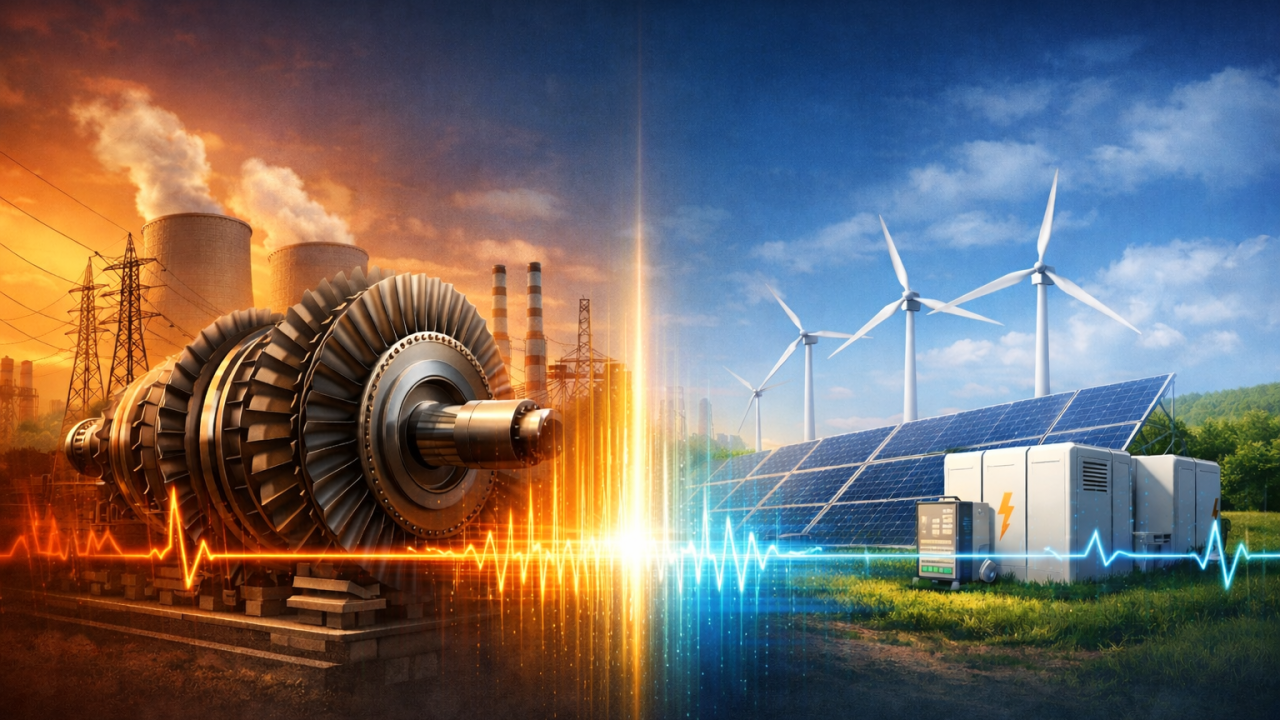
For decades, inertia was an inherent feature of power systems, provided automatically by large rotating machines. As power grids evolve toward inverter-dominated architectures, inertia is no longer guaranteed by physics and increasingly depends on how systems are designed and controlled. Understanding why inertia matters is the first step in understanding how its character is changing.
Why Inertia Matters?
Frequency in a power system is a direct reflection of the balance between generation and demand. Any sudden mismatch—such as the loss of a generator, a large load connection, or a network disturbance—causes the system frequency to deviate from its nominal value. If generation falls short of demand, frequency begins to decline; if generation exceeds demand, it rises. These frequency changes are not just numerical deviations but clear signs of stress in the system. Rapid frequency excursions can lead to protection maloperation, unwanted tripping of generators and loads, and in extreme cases, cascading outages and system collapse. The faster the frequency changes, the less time is available for controls, reserves, and operators to act. This is where inertia matters: it is the ability of the power system to slow down the rate of frequency change, giving the grid the time it needs to respond and stay stable.
Natural Inertia in Conventional Power Systems
In conventional power systems, inertia is mainly provided by synchronous generators connected directly to the grid. These machines have large rotating masses, such as turbines and generator rotors, which store kinetic energy while operating at synchronous speed. When a disturbance occurs and frequency starts to change, this stored kinetic energy is released or absorbed automatically, without any control action or delay. This inherent physical response opposes rapid frequency changes and provides an immediate stabilizing effect. Because this inertia is tied directly to the machine’s mass and speed, it is always available as long as the generator is connected and synchronized to the grid. This immediate response plays a critical role in the first few seconds following a disturbance, when no control system or reserve has yet had time to act. During this period, inertia limits the rate at which frequency changes, preventing sudden and extreme deviations. For instance, after the sudden loss of a large generator, the kinetic energy released by other synchronized machines helps supply the shortfall, slowing the frequency decline. Similarly, following a sudden loss of load, the machines absorb excess energy, restraining a rapid rise in frequency. By moderating these initial dynamics, inertia creates a stable time window that allows primary frequency control, protection systems, and operator actions to respond in an orderly manner.
Declining Inertia in Modern Power Systems
In modern power systems, the amount of available inertia is steadily reducing as synchronous generators are replaced by inverter-based resources such as wind, solar PV, and battery energy storage systems. These resources connect to the grid through power electronic converters, so system frequency is no longer directly tied to any rotating mass and physical inertia is not naturally available. As a result, the grid experiences faster frequency changes following disturbances, higher rates of change of frequency, and reduced time margins for protection and control actions. This shift increases the risk of unintended protection trips, challenges frequency containment, and places greater dependence on fast-acting controls and reserves. Grid operation therefore becomes more sensitive to disturbances, requiring tighter coordination, improved monitoring, and deliberate design of frequency support mechanisms.
Synthetic Inertia in Inverter-Based Power Systems
In low-inertia grids, synthetic inertia is provided through control strategies implemented in inverter-based resources. These strategies rely on algorithms that continuously monitor system frequency and its rate of change, and command the inverter to quickly inject or absorb power following a disturbance. This fast power response is designed to oppose rapid frequency changes in a manner similar to the inertial behavior of synchronous generators. The energy used for this response does not come from rotating masses, but from the energy source connected on the DC side of the inverter, such as batteries, wind turbine kinetic energy, or stored electrical energy in DC-link capacitors. In conventional generators, large rotating masses naturally played the role of energy buffers. In inverter-based systems, this role is taken over by controlled energy sources enabled by fast power electronics, making inertia an actively managed feature rather than a passive physical property of the grid.
While synthetic inertia can significantly improve frequency response and support grid stability, it introduces new challenges related to coordination, energy limits, and interaction with protection systems. As inertia transitions from a passive physical characteristic to a feature shaped by control design, careful system-level engineering becomes essential to ensure reliable and predictable grid operation.
Leave a Reply